ATE or ATG: which Humidistop device to choose against damp walls
Your walls show traces of damp at the base of the partitions and you have ruled out heavy building works. ATE or ATG: the question comes up in almost every request for advice sent to Humidistop, and it is settled quickly, provided you look at the right criterion. Both ranges pursue the same purpose, acting on water molecules to stop their progress through the masonry. What separates them is the technology, and above all what your building allows.
The same purpose, two technologies
The ATE emits very low frequency electromagnetic waves that reverse the polarity of the water molecules and gradually push them back towards the ground. The ATG Geostop picks up the natural magnetic fields of the building and returns a phase shifted counter field that blocks the capillary rise, the walls then drying out through natural evaporation.
Set against conventional solutions, the difference is clear. Chemical injection requires heavy works and partially blocks the water. Drainage requires excavation and channels water away from around the building. A dehumidifier dries the air, not the walls, with a short term effect. These heavy works can run into several thousand euros, whereas the ATE and the ATG act on the walls, over time, with no chemical products.
The ATE range: wired, discreet, recommended as a priority
The ATE plugs into an earthed socket and stays connected permanently, for a very low consumption of around 0.75 W, that is around 15 € per year. CE certified, it complies with directives 2014/35/EU, 2014/30/EU, 2011/65/EU and 2012/19/EU. Tests by the Emitech laboratory concluded that there is no harmful radiation, with emissions comparable to those of a microwave oven or a hairdryer, with no harm to the health of people, animals or plants.
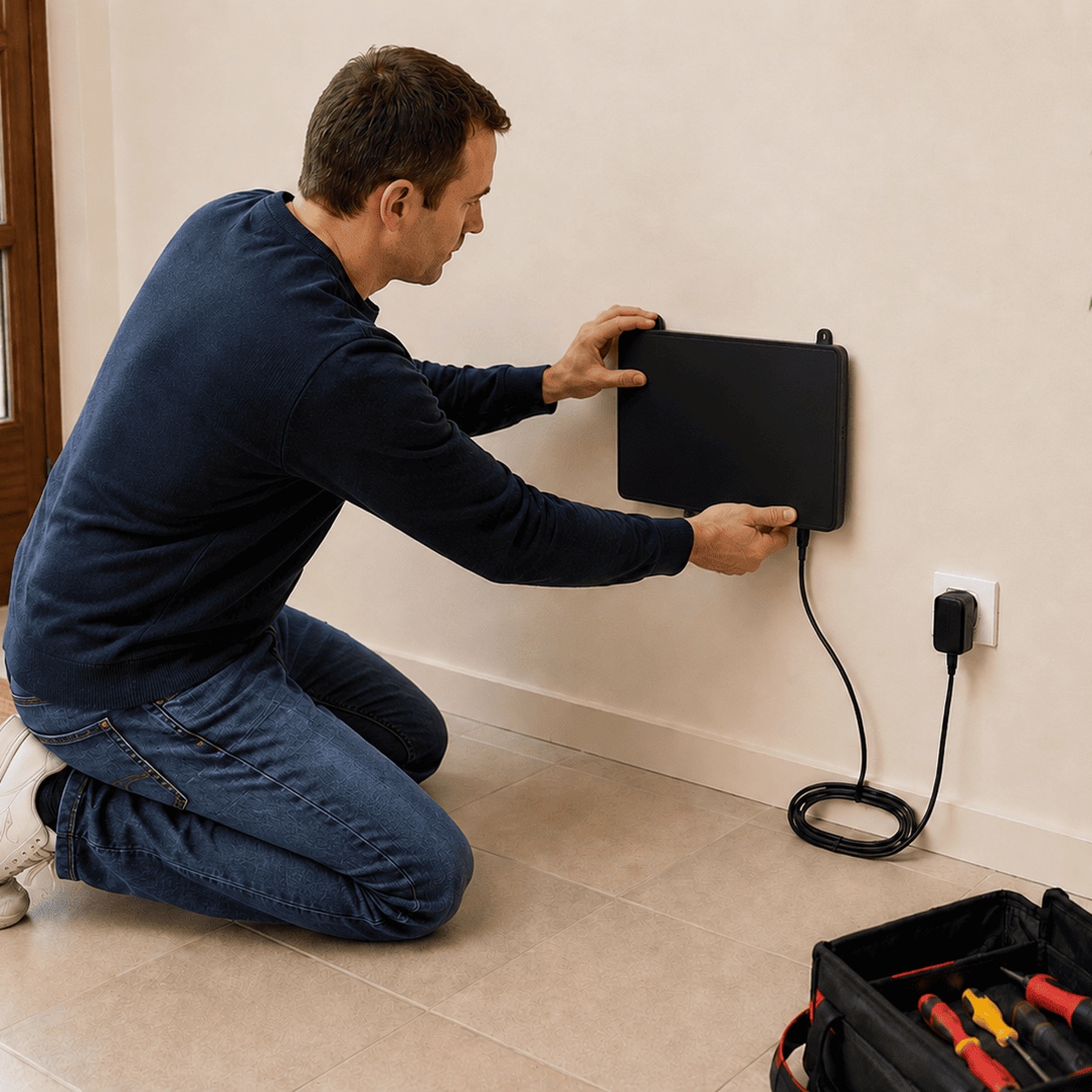
Fitting it is much like hanging a picture frame, with no drilling. The device must be placed on a damp wall, within the affected area, on a load bearing or cross wall, between 30 cm and 1 m from the floor, and 1.5 m away from any other electrical equipment, then left plugged in permanently.
Coverage is expressed as a diameter of action: 15 m for the ATE LC15, 30 m for the ATE LC30 (the best selling model, also stocked by Leroy Merlin and Castorama), 60 m for the ATE MAX, the most powerful. The ATE Pulse offers the same power as the LC30, with a modern design. This is the range that Humidistop recommends as a priority.
The ATG Geostop range: standalone, passive, with no electricity
The ATG Geostop works with no electricity, no battery and no maintenance. Made up solely of passive circuits, it contains no active electronic component and emits no electromagnetic wave.
The unit is fixed to a load bearing wall, between 1.50 m and 2 m from the floor, oriented towards the north with a compass, at least 1.50 m away from any electrical source (wall sockets being the exception), on a clean and flat surface, with strong double sided tape or a suitable adhesive, with no drilling. Once fitted, it must not be moved again. Coverage follows the same logic: 15 m, 30 m and 60 m in diameter for the LC15, LC30 and MAX models.
This range is recommended when installing an ATE is not possible: second homes, public buildings, agricultural buildings, plant rooms or listed premises, rooms with no socket. The French Ministry of the Armed Forces highlighted the ATG Geostop solution in its request for Hôpital Bégin.
ATE or ATG: the decisive criterion and the right sizing
The ATE or ATG question is settled with a single query: do you have a usable earthed socket, on a permanent supply, close to the damp wall? If so, it is the ATE, recommended as a priority by Humidistop. If not, it is the ATG Geostop, designed precisely for these situations.
That leaves the sizing, which follows a geometric rule: the maximum diagonal of the area to be treated must fit within the diameter of action of the model chosen. Humidistop does not carry out home surveys, as these visits are “often billed indirectly by certain companies, which generates unnecessary costs for the customer”. A few photos of your walls are enough.
Is an LC30 enough for a whole house?
The LC30 covers 30 m in diameter, that is a radius of 15 m, and it is the best selling model. Compare the maximum diagonal of your property with this diameter: if it is larger, the MAX and its 60 m take over.
Do these devices pose a health risk?
No. Tests by the Emitech laboratory on the ATE concluded that there is no harmful radiation, with emissions comparable to those of everyday household appliances. The ATG, entirely passive, emits no wave. Both ranges cause no harm to the health of people, animals or plants.
ATE or ATG: let your building decide
Choosing between ATE or ATG means asking a question about your property, not about the technology. An available earthed socket and an accessible damp wall: it is the ATE. No permanent connection: it is the ATG Geostop. In both cases, the foundations are identical: French manufacturing in an ISO 9001 certified factory, a 10 year manufacturer’s warranty, direct selling at direct factory prices, payment available in 3 or 4 interest free instalments, and results generally visible within 18 to 24 months by following the drying recommendations (stripping back film forming renders, ventilation, mineral anti salt renders, a drain in case of lateral infiltration).
Send a few photos of your walls to be guided free of charge, then choose your device. A question about coverage or positioning? Write to the Humidistop team.