How to Make More Money as a Builder: Add Damp Treatment to Every Job
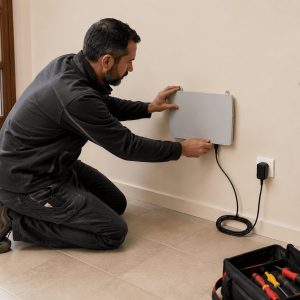
How to make more money as a builder without spending a penny on marketing starts with a line item you can already justify: treating the rising damp behind the job you’re quoting anyway. It sits alongside a paint job, a stud wall, tiling or a render, fits in minutes, and the unit itself can be ordered one at a time from Help Humidité Pro.
How to Make More Money as a Builder: What Counts as a Genuine Add-On
An add-on, not an upgrade
Upgrading means offering a better version of the same job — a higher-spec paint, a thicker tile. An add-on is something different, sitting next to the job the customer came for: treating the wall underneath the paint, for instance.
It has to be earned
Charging for a line the customer doesn’t need wins you one invoice and loses their trust. A fair add-on is justified by what you can actually see on site.
The three conditions for a legitimate add-on
- A need you can point to: the stain at the base of the wall, the salts, the swelling skirting board are visible during the visit.
- A direct link to your own trade: without treating the cause, your paint, your stud wall or your render will fail again.
- A result and limits you can state honestly: a visible improvement after roughly 18 to 24 months in general, and a device that treats rising damp only — no effect on water infiltration, flood damage or surface mould.
Polarity inverter treatment ticks all three boxes once the survey confirms rising damp. Where it doesn’t, leave it off the quote. Get this filter right and you’ve already found how to make more money as a builder without losing anyone’s trust.
Add-On Examples by Trade
Painter
The customer wants a room repainted and the bottom of the walls is blistering. The paint stays the main job; treating the wall, stripping the sealed paint low down and finishing with a breathable coat sit alongside it. See also: damp wall at the bottom, what to do before painting.
Plasterer
A stud wall due for replacement on a rising damp load-bearing wall: stripping the old lining, fitting the device against the bare masonry, and a new stud wall on the second visit make three clean lines on the quote.
Tiler
Tiles lifting at the base of a wall usually flag damp masonry underneath (loose wall tiles at the base of a wall). Glued tiling at floor level blocks evaporation, so stripping it out and treating the wall come before the new tiles go on.
Renderer
Cement render dropping off in slabs at the base of a wall: hack off, treat the wall, correct the water entry points, then a lime finish once the wall has stood bare for months. Full method here: how to render a damp wall, step by step.
Bricklayer on older buildings
On a long farmhouse wall or a large older property, the distance to cover from the fitting point can call for an ATE MAX, which works across a 60 m diameter. Repointing and a lime finish follow later, once the wall has been left bare for months.
Raising It Without Pushing the Customer
The right moment is the survey, before the quote goes out. A line that appears mid-job looks like a charge forced on the customer.
Step 1: Show them what you see
Point out the stain, the top edge, the salts, the damaged skirting to the customer. A minute is enough, and they’re the one who connects it to your own job.
Step 2: Explain the cause and the limits
Explain that water rises through the masonry from the ground and that the device gradually sends it back down. State clearly what it doesn’t treat. Help Humidité Pro’s diagrams and explanatory sheets make the explanation concrete.
Step 3: Price it as its own line
Present the treatment as a separate option: model, working range, timeframe and the manufacturer’s 10-year warranty. The customer keeps the choice, you keep their trust.
Step 4: Follow up
After fitting, mark a dated pencil line on the wall showing how high the damp reaches. Warn the customer the wall may look whiter for a while as salts come out. The finishing work at the base of the wall, months later, brings you back to the same customer.
The Numbers: Stocking Up Through Help Humidité Pro
This extra line pays twice over: the margin between the trade price you pay for the unit and what you charge for it, plus the hours on the related work — stripping sealed coatings, removing old linings, fixing outside water sources and finishing off. On logistics, there’s nothing to warehouse:
- two-minute registration with your company details, access unlocked straight away;
- order from a single unit, with discounts once quantities rise;
- free delivery, arriving within 7 working days, paid by bank transfer or PayPal;
- ready-made copy you can drop onto your own site and paperwork;
- units made in France, in Castres, backed by a 10-year manufacturer warranty;
- no franchise network, no fixed-term contract, no exclusive territory.
The model follows the range you need to cover: the ATE LC15 over a 15 m diameter, the ATE LC30 and its newer version, the ATE Pulse, over 30 m. The ATE, plugged into an earthed socket, stays the first choice; the ATG is for cases where no such socket is permanently available. The installation guide sets out the fitting conditions in full.
Frequently Asked Questions
Is this an upsell or an add-on sale?
The two terms overlap heavily. Either way, you’re offering something linked to the main job. Upgrading, by contrast, replaces the job with a higher-spec version of the same thing.
What’s a good example of an add-on in construction?
A job that protects your own work: treating rising damp before repainting, re-lining, tiling or rendering a damp load-bearing wall.
How do you avoid the customer feeling pressured?
Show them the problem, state the limits plainly, price it on its own line, and raise it at the survey. A customer who understands the reasoning decides for themselves.
Do you need to hold stock?
No. On the Help Humidité Pro shop, you order as jobs get signed off, even a single unit at a time, and delivery costs you nothing.
In Brief
A solid add-on starts from a need you can point to, and protects your own work. Rising damp treatment sits naturally alongside painting, plastering, tiling, rendering and bricklaying jobs. Show it, explain it, price it separately, follow the job through. That’s how to make more money as a builder without spending a penny on new leads. Registering with Help Humidité Pro takes two minutes, with no minimum order — the line can be on this week’s quote.