Crumbling External Render at the Base of a Wall
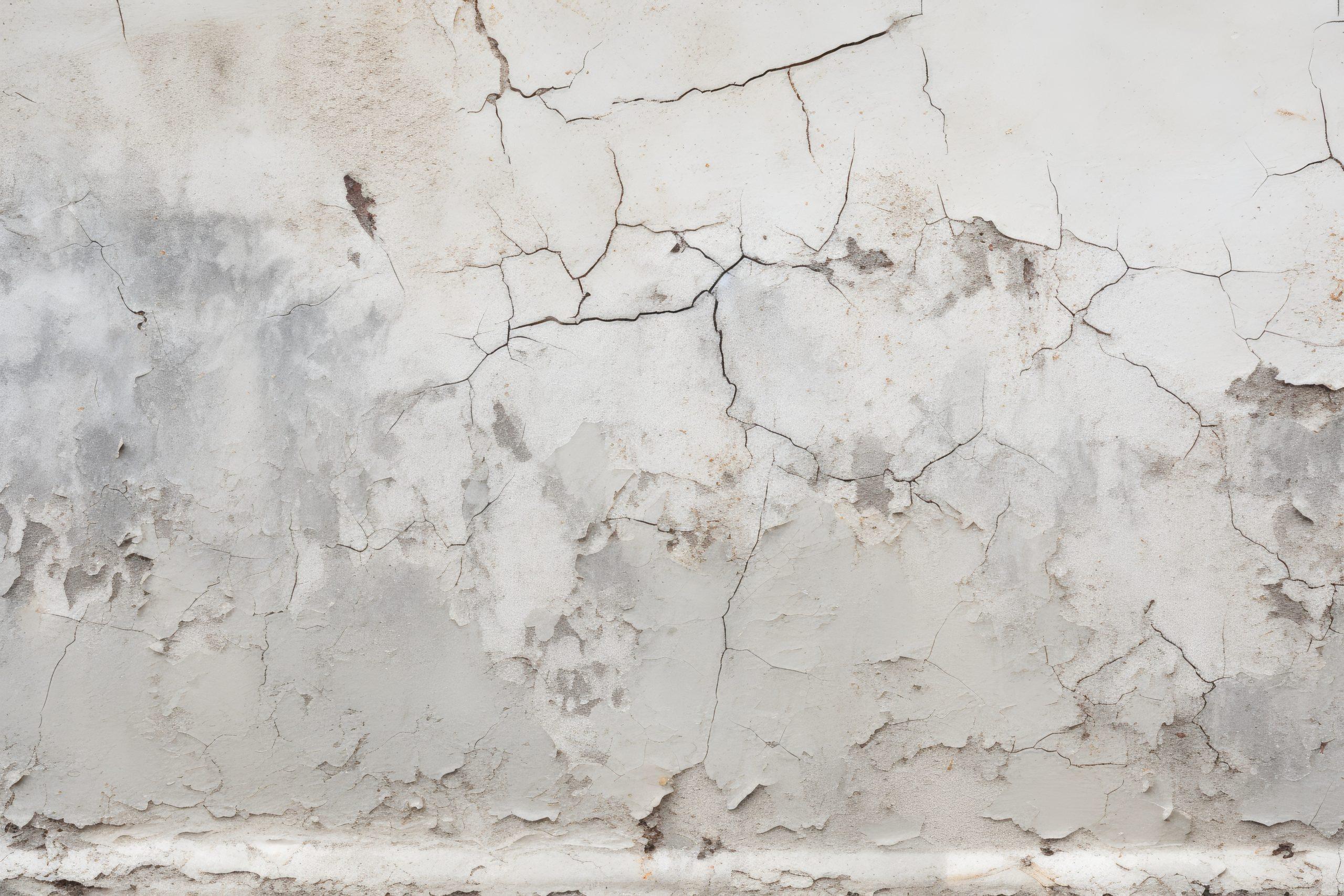
Crumbling external render at the base of a wall nearly always tells the same story. Water rises from the ground through the masonry, evaporates at the outer face and leaves its salts behind. So here is how to read that damaged band, what it means for the inside, and in which order to act.
Why external render fails from the bottom up
Water leaves wherever it can
Masonry soaked with water releases it through its faces. Yet the façade meets the most air and wind. Evaporation therefore concentrates there, just above ground level.
Salts do the rest
Ground water carries mineral salts. As it evaporates, it abandons them inside the render. Those salts then crystallise and expand. Consequently, they burst the mortar from within.
Frost accelerates the damage
Saturated render copes poorly with frost. Trapped water expands, then detaches whole plates. So the decay advances most after a wet winter.
Crumbling external render: reading the pattern
A continuous band at ground level
If the render crumbles at an even height along the whole façade, the diagnosis points to rising damp. Moreover, the same height often appears indoors.
A patch under an overhang or a downpipe
Damage concentrated below a gutter, a window or a flashing indicates one entry point. It then follows rainfall.
Blisters scattered without logic
Blisters spread across the whole surface suggest an adhesion fault or an unsuitable paint instead.
Our page on rising damp sets out each sign.
Mistakes that make crumbling external render worse
Rebuilding it in cement
This is the most frequent error. Cement passes vapour poorly, so it traps the water. That water then climbs higher, and the new render fails in turn.
Applying a film-forming paint
Sealed masonry paint closes the last escape route. It blisters within a few seasons and pulls the render off as it lifts.
Fitting cladding over the top
Cladding hides the mark, yet it blocks evaporation. In this way moisture concentrates behind it and advances through the wall.
Adding external insulation without treating
Insulation fitted to a saturated wall imprisons the water. As a result, the problem becomes invisible and far more expensive to put right.
Laying paving tight against the façade
A terrace or path at wall level extends contact with wet soil. It therefore feeds capillary action continuously.
Crumbling external render: what to check around the building
A walk around the house on a wet day settles many questions.
Look at the gutters and see whether they overflow. Then follow the downpipes to the ground and confirm the water leaves well away from the façade.
Check gullies and gratings. A blockage creates a permanent puddle at the base of the wall.
Finally observe the ground slope. Ideally the ground carries water away from the building. Often the opposite happens.
Treat the cause before renewing crumbling external render
Several methods exist: resin injection, a physical damp proof course, perimeter drainage and polarity inversion. Yet only the last avoids drilling the masonry.
The principle rests on a physical property of water. Each molecule carries two opposite charges, and that imbalance drives it upward through the wall. A low-frequency signal disturbs the dynamic, so the flow reverses and travels back down.
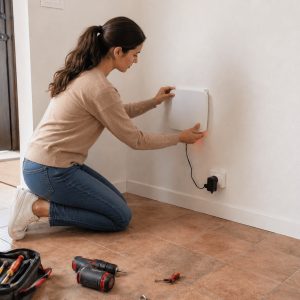
Two families exist. The ATE series plugs into an earthed socket and costs around €15 of electricity a year. The ATG series runs with no supply, although we reserve it for cases where fitting an ATE proves impossible.
As for placement, choose the worst affected stretch of a load-bearing wall and work at floor level. The background must be flat, and the unit must touch the masonry itself with no lining in between. Coverage then decides the rest: the ATE LC15 spans 7.5 metres around it, the ATE LC30 reaches 15 metres, and the ATE Max covers 30 metres.
The limit of this technology deserves repeating. Its scope stops at water rising from the ground. A failed roof, a flood or surface mould all call for different answers.
Which external render to choose next
Lime mortar
On older buildings, lime remains the coherent option. Indeed, it passes vapour and follows the movement of the wall. Furthermore, it tolerates salts better than a rigid mortar.
Renovating render
This macroporous type holds salts within its thickness while letting vapour escape. It therefore delays the return of damage. However, it saturates over time.
The finish
Choose a mineral paint, silicate or lime based. By contrast, plastic paints seal the façade again.
A realistic timeline
Faced with crumbling external render, many owners redo the façade too early and pay twice.
Start by hacking off the failed render and leave the wall open. That state may last several months, which is entirely normal.
Then fit the treatment and fix outside water sources. From that point, real drying begins.
Check every three months afterwards. Photograph the façade and note the height of the mark at the same spots.
Finally, renew the render once the wall reaches a stable level. When you follow our installation guidance, you generally see improvement between 18 and 24 months.
Frequently asked questions
Does crumbling external render always mean rising damp?
No. An adhesion fault or one entry point produces the same result. However, an even band at ground level points strongly to the soil.
Can I simply patch the damaged areas?
You can, but the repair will fail. While the wall holds water, salts will return to the same place.
Should the treatment go inside or outside?
The unit fits indoors, on a damp load-bearing wall. It acts on water within the thickness, so the façade benefits as well.
Does external insulation solve the problem?
No. On the contrary, fitted to a saturated wall it traps the water and makes any later repair far costlier.
How can I confirm the source?
Send us photographs of the façade and of the internal wall base. We then point you in the right direction, free of charge and with no site visit.
In short
Crumbling external render at the base signals water inside the masonry and salts crystallising beneath the surface. Renewing it without treating the cause restarts the cycle.
Read the pattern of damage, fix outside water sources, treat the cause, then re-render with a breathable material. To find the right model, visit the shop, or write to us through the contact form.