Rising Damp Height: What Sets the Limit
Rising damp height often surprises owners. Some walls stop at thirty centimetres, others climb well past a metre. So here is what sets that limit, how to measure it properly, and what its movement tells you about the real state of the wall.
What determines rising damp height
The size of the pores
Water climbs higher where pores are finer. A porous brick or a lime mortar therefore lets water travel further than a dense stone. Moreover, one wall often mixes several materials, which makes the mark uneven.
The balance between supply and evaporation
The level settles where incoming water equals evaporating water. Consequently, anything that hinders evaporation pushes the limit upward. Cement render, sealed paint or dry lining produce exactly that effect.
The thickness of the wall
A thick wall holds more water and dries more slowly. So the mark tends to sit higher there than on a thin partition.
How much water the ground holds
Soil that retains water feeds the masonry continuously. As a result, the height advances while the source persists.
A realistic range, and its exceptions
In most homes the band sits between the floor and roughly one metre. However, that is no physical law.
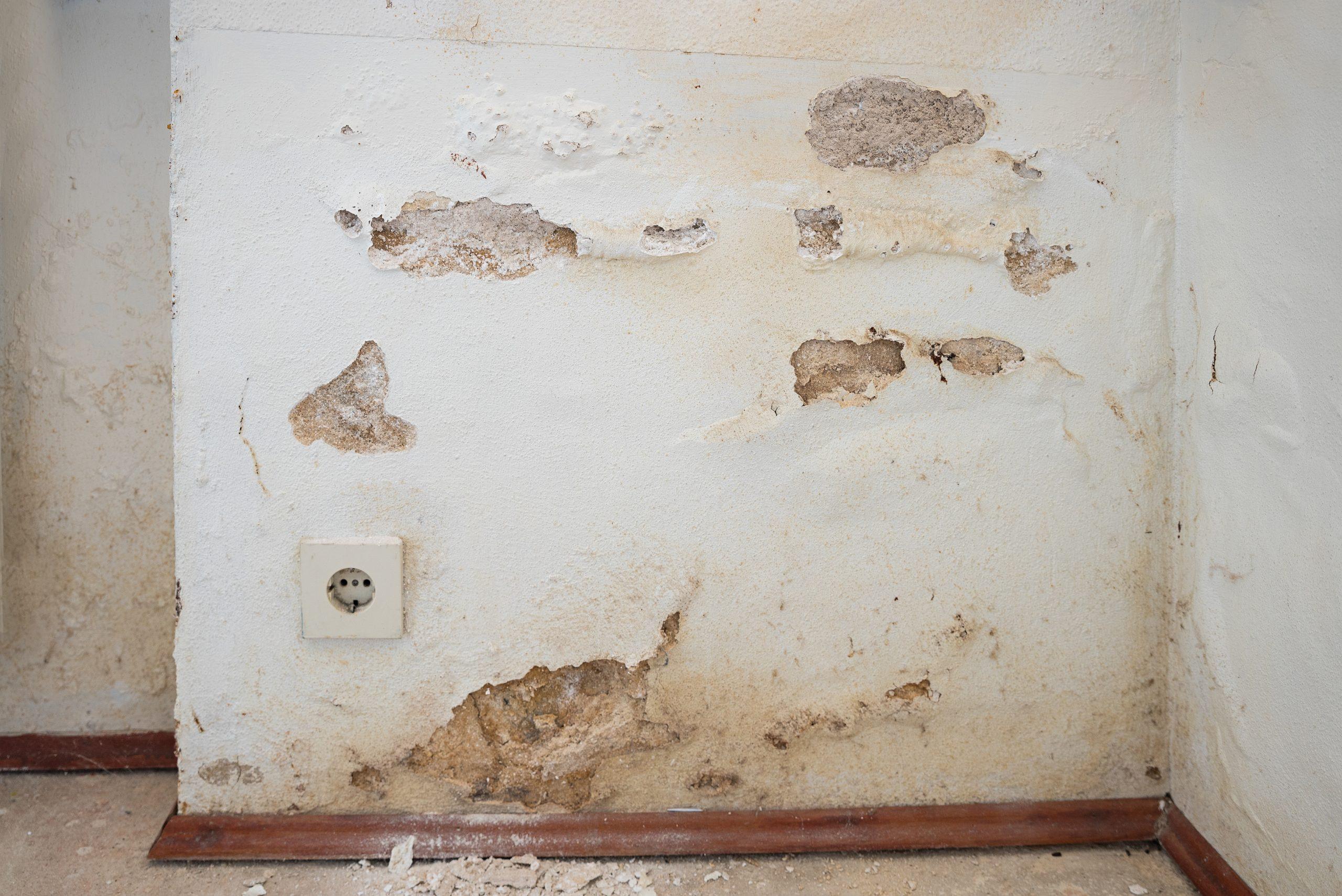
Where the surface is closed by a sealed finish, the limit climbs. Water then seeks an exit higher up, sometimes at a metre and a half or beyond.
By contrast, a bare, well-ventilated wall usually keeps a low mark. Indeed, evaporation matches supply nearer the ground.
So remember the principle rather than the figure. A considerable height does not mean a hopeless case. Above all, it signals a wall that no longer breathes.
Measuring rising damp height properly
Take readings at several points
Measure the upper edge at three places at least on the same wall. Then repeat on two other walls. An even height points to the ground.
Mark discreetly
Draw a light pencil mark. In this way, the next reading happens at exactly the same spot.
Note the date and season
A wall marks more in winter than in high summer. Without those details, two readings cannot be compared.
Photograph
A dated photograph, straight on and then wide, is worth as much as the figure. It allows a comparison in six months.
Look outside as well
Step out and observe the same wall from the façade. A mark at similar height confirms water sitting within the thickness.
What the movement of rising damp height tells you
This is the most useful point in the whole article.
A limit that climbs almost always indicates a sealed finish laid too low, or dry lining closed back up. Water no longer escapes at the base, so it advances.
A stable limit signals a balance between supply and evaporation. The wall is not worsening, yet it is not drying either.
A limit that falls reflects drying under way. That is the sign you await after treatment.
Finally, beware a visual trap. As water evaporates, it leaves salts at the surface. A wall that is improving may therefore look temporarily whiter, even while the mark recedes.
When the height does not mean rising damp
Three cases mislead regularly.
An isolated patch high up, appearing after rain, belongs to weatherproofing: roof, windows or a façade crack.
Black mould in cold corners, without a continuous low band, comes from indoor air.
A localised point near pipework signals a leak. Close every tap and watch the meter for an hour.
Our page on rising damp sets out the signs that tell them apart.
Bringing the height back down
Two levers work together.
The first reopens the exit. Strip sealed finishes low down, cement render, closed paint or bonded tiling. Remove dry lining across the affected areas as well. Finally, pull furniture away from the wall.
The second treats the cause. Several methods exist: resin injection, a physical damp proof course, perimeter drainage and polarity inversion. Yet only the last avoids drilling the masonry.
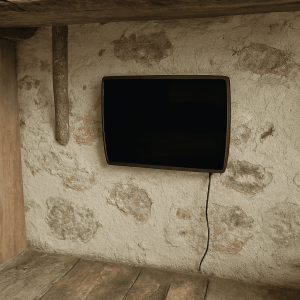
The principle rests on a physical property of water. Each molecule carries two opposite charges, and that imbalance drives it upward. A low-frequency signal disturbs the dynamic, so the flow reverses.
The ATE series plugs into an earthed socket, for roughly €15 of electricity a year. The ATG series runs without power, although we reserve it for cases where fitting an ATE proves impossible.
The unit fixes at floor level, on a damp load-bearing wall, in direct contact with the masonry. Coverage depends on the model: the ATE LC15 acts over 7.5 metres around it, the ATE LC30 over 15 metres, and the ATE Max over 30 metres.
One reminder matters. These units treat rising damp. By contrast, they treat neither water penetration, nor flooding, nor surface mould.
How long before the mark recedes
Saturated masonry releases its water slowly. Patience therefore forms part of the process.
When you follow our installation guidance, you generally see improvement between 18 and 24 months. Useful signs arrive earlier. The limit first stops climbing, then settles, before it starts to fall.
Keep measuring every three months, at the same points, noting the date. That is the only way to obtain a reliable trend.
Frequently asked questions
Is there a maximum rising damp height?
No absolute value exists. The limit depends on pore size, wall thickness and above all on how freely the surface evaporates.
Why does the mark climb after building work?
Because a sealed finish or dry lining has closed the low exit. Water then seeks to evaporate higher up.
Is a high mark more serious?
Not necessarily. It mainly indicates a wall that no longer breathes. Reopening the base often brings the limit back down.
Do I need a meter to measure it?
A tape and a pencil are enough to follow the height. A moisture meter supports the observation without replacing it.
How do I confirm the ground is the source?
Send us photographs of the affected walls with the height noted. We then point you in the right direction, free of charge and with no site visit.
In short
Rising damp height depends on the material, the thickness of the wall, the water available in the ground and above all on surface evaporation. It has no fixed ceiling.
Measure at several points, note the date, follow the trend, reopen the base and treat the cause. To find the right model, visit the shop, or write to us through the contact form.